

Asking myself simple questions about the Paris Olympics 2024 mascot gradually began a quest and became my obsession. Does the Olympics 2024 mascot have a gender? Why are they bright red and look like a stuffed Eiffel Tower? My in-depth research into these burning questions has been fruitful.
I read about the mascots in my daily newspaper Le Parisien. My initial reaction when the two mascots were unveiled in November 2022 was not very positive. Their design does not strike me as elegant. The red color is bright and harsh. Curious, I started following this unusual stuffed toy. Without realizing it, the research has become an obsession. My eyes and curiosity carried me to fantastic discoveries. My research took me to the story behind the design, the made in France versus made in China issue, antiquity history and unexplored sections of the Louvre, Carnavalet Museum, French art and the Bastille.
How I Conducted the Search
Two weeks after the mascot announcement I spotted a Phrygian cap on the bronze statue “Liberty” in the metro station Louvre-Rivoli. Stepping off the platform in Bastille station near my apartment, there was another Phrygian cap. In fact, the tiles on the platform in the direction of Vincennes has the most painted Phrygian caps in one place.

Answers to “what is it?” came from newspaper articles and browser searches. French revolutionaries and other revolutionaries wore it as a symbol of liberty and freedom. In a novel’s chapter I am reading, the cap is mentioned when Lord John Grey dons a Phrygian cap during the American Revolution.
The Story Behind the Mascot Design

Now more on the initial question of gender from above. The mascots (in French mascotte, a feminine noun) are two “heroines” designated as leaders of a Phryges tribe. Here are two theories why they are feminine: One, during the French revolution, women led the march to Versailles. Peacefully in this case, the two Phryges are leading their tribe with one conviction: “sports can change everything”.
Another reason could be the French word “mascotte”, which is a feminine noun. The Phryges tribe represents the various games in the Olympics. The Phryges personalities symbolize French societal differences. The Paralympic Phryge is “extroverted, party-going and a little hot-headed”. The Olympic Phryge is “smaller, more careful, thoughtful, seductive and a little snooty”.
Made in France vs. Made in China (Quantity vs. Quality)

Two French toy companies received the production bid, Doudou et Compagnie and Gipsy Toys to manufacture the fluffy, stuffed Phrygian caps. Both had already moved their operations to China years ago. Thus, on the majority of the Phryges is written made in China on the label. For the Olympics, Doudou et Compagnie moved some production back to France to an abandoned supermarket. They are producing a limited number of the made in France Phryges in Brittany.
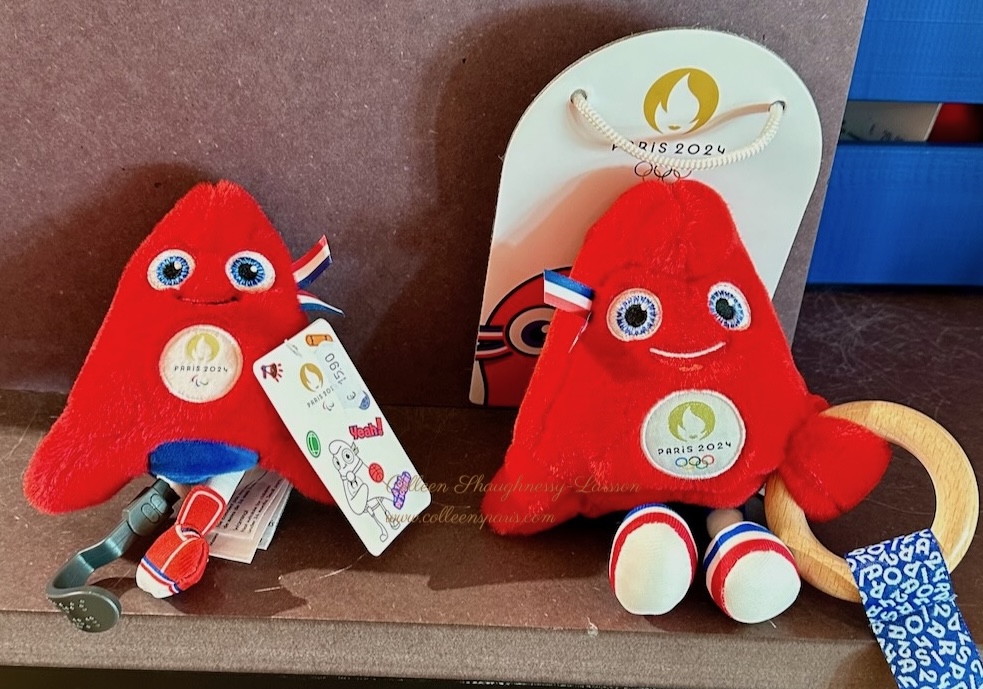
The appearance and feel is different between the plush toys. In the made in France version, my fingers feel the fur, which is fluffier, softer and longer. My eyes see the difference in the glint in the Phryges’s eyes. They have more detail. The prosthesis differs between the two versions. On the Paralympics toy made in France the prothesis is plastic. In the made in China version, the prothesis is cloth and the fur and the eyes are flatter.
Why the Phrygian Cap?
The Phrygian cap is a French symbol representing liberty and freedom with its beginnings in antiquity. Freed slaves in Roman antiquity wore the cap called “pileus”. Knowing that, I chanced that Greek antiquities at the Louvre would be a perfect spot to find a Phrygian cap, which originated in Phrygia (part of modern Turkey).

In a browser search of the Louvre, I found Athena standing under a dome Greek Antiquities section wearing a cap. The cap turned out to be a Corinthian helmet but I was in the right room. Inspecting the other statues in the same room, I found the Trojan hero, Paris. He was wearing the Phrygian cap. Not an emancipated slave, he did, however, cause the Trojan War.

During the period of Enlightenment, the cap became a symbol of human rights. During the French Revolution, it took on the meaning of “Liberty or Death”. The City of Paris’s Carnavalet Museum’s French Revolution section has numerous cap examples in paintings, coins and sculptures. On one coin, French citizen Louis XVI wears the Phrygian cap. The apex is toward the back instead of the front. The position of the apex is contrary to the norm.
As I move to the modern era at the Louvre, Eugène Delacroix uses the cap in at least two of his paintings at the Louvre Museum. The most famous is “Liberty Leading the People” painted for the July Revolution of 1830. An overwhelming variety of souvenirs at the Louvre use “Liberty” as the main subject.
Buying the Mascot and Olympic Souvenirs
Within the first week of January 2024, most of the shelves in the stores selling the mascot souvenirs have been wiped clean from the holidays. As of today, only a few Olympic collector coins and one tote bag exist at La Poste (the French post office) in my Bastille neighborhood. The stores I revisited (Galeries Lafayette and the Paris Tourist Office) will replenish their shelves. Two main official stores are now open at Les Halles and the Carrousel du Louvre (the largest). Souvenirs are available online at an olympic shop as well as on Doudou et Compagnie (https://doudouetcompagnie.com/fr/catalogue/mascotte-officielle-paris-2024) et Compagnie and Gipsy Toys (https://www.gipsytoys.com/en/108-the-mascots-of-paris-2024).
Additional locations for Paris Olympic Souvenirs
- Bring France Home (3 rue de Birague 75004) near Places des Vosges has a large selection of Olympics 2024 souvenirs; all made in France or visit them online. They only sell souvenirs 100% made in France.
- The official online shop for Olympics souvenirs
- Official Shop Paris 2024 – located at Carrousel du Louvre
- Doudou et Compagnie – online shopping Paris 2024 products made in France
- Gipsy Toys online shopping
Paris Olympics 1900 and 1924
This is the first Paris Olympics with not one, but two mascots. After two years of branding and design work, Tony Estanguet, President of the Paris 2024 Organising Committee for the Olympic and Paralympic Games and three-time Olympic champion unveiled the mascots in November 2023. As a piece of trivia, Paris 1924 had the first Olympic village to house and feed athletes.

Olympic cities only began the use of designing a mascot, usually an animal, in 1968. The Paris Olympics of 1900 and 1924 had no mascot. In a nod to the 1924 Paris Olympics, the 2024 logo is using neo-Art Nouveau typography, colors and design style. The logo is not the mascot but three symbols of the French Olympics: the gold medal, Marianne and the flame.
The Olympic souvenir fever is starting. I bought a tee shirt at Galeries Lafayette in a size larger than normal for me. A woman had a mascot key chain dangling from her backpack. My heart started racing. I believe I am catching Paris Olympic 2024 souvenir fever!

Phrygian cap Olympics 2024 souvenir Louvre Carrousel shopping center 
Phrygian Cap – tiles in Bastille metro station work of Liliane Belembert and Odile Jacquot 1989 
Phrygian Cap tiles in Bastille metro station work of Liliane Belembert and Odile Jacquot 1989 
Phrygian cap souvenirs in the Louvre museum Delacroix’s painting Liberty Leading the People 1830 
Eugène Delacroix’s 1830 Liberty Leading the People Louvre Museum 
Eugène Delacroix’s 1822 Detail of Dante and Virgil in Hell or The Barque of Dante Louvre Museum on character sporting a loose version of the Phrygian cap Paris, a Trojan hero – Greek Antiquities marble statue in the Louvre Museum wearing a Phrygian cap 
Athena wearing a Corinthian helmet Louvre Museum Greek Antiquities turned out not to be a Phrygian cap Metro Louvre-Rivoli Bronze statue « Liberty » 1856 Pierre Jean David d’Angers wearing a Phrygian cap, French’s ongoing struggle for human rights. 
Mascot label Made in France for Paris Olympics 2024 
Souvenir shop in the shopping mall of the Carrousel du Louvre for the Olympic 2024 
Souvenir shop in the shopping mall of the Carrousel du Louvre for the Olympic 2024 
Image of souvenir stamps for the Paris Olympics 2024 
Image of post office products with the Paris Olympics mascot theme 
Image of souvenir coins for the Paris Olympics 2024 sold at La Poste (French post office) 
Detail of the Monument à la République and Phrygian cap, granite and marble Erected May 7, 1879 Place de la République formerly Place du Château-d’Eau https://fr.wikipedia.org/wiki/Marianne “Avant-garde des femmes allant à Versailles” (octobre 1789). Eau-forte coloriée. Paris, musée Carnavalet. 
Paris Olympics 2024 Mascots tribe Differences between Made in France and China; the fur, the eyes and the prosthesis 
Phryges mascots for Paris Olympics and Paralympics 2024 Medallion of tin with image of “Le Citoyen/citizen” Louis XVI wearing a Phrygian cap with cockade. Carnavalet Museum Logo of Olympics and Paralympics 2024 with the gold medal, flame and Marianne symbols 
Pirámide de Mayo located at the hub of the Plaza de Mayo, is the oldest national monument in the City of Buenos Aires one of several emblematic sculptures porting the Phrygian cap in Buenos Aires. 
Museo Marítimo y del Presidio de Ushuaia (Maritime Museum in Ushuaia, Argentina) Police emblem for the penal prison. The 19th-century prison building houses the maritime, Antarctic, jail & marine museums
